Amazon Product Research: How to Find a Product Worth Selling
Amazon Product Research: How to Find a Product Worth Selling
Amazon product research is where most failed private label launches actually go wrong, long before the first unit ever ships. A product can have a great listing, solid PPC, and a well-run Storefront behind it and still lose money, because the underlying choice of what to sell was never validated properly. Good research does not guarantee a winner, but skipping it reliably produces losers.
What Product Research Is Actually Trying to Answer
Strip away the tools and the spreadsheets, and product research is answering one question: is there a group of people searching for this on Amazon, in enough volume, who are not already well served by existing listings, at a price where you can make a profit after fees. Everything else, demand data, competition counts, margin math, exists to answer that one question with evidence instead of a guess.
The Criteria That Actually Matter
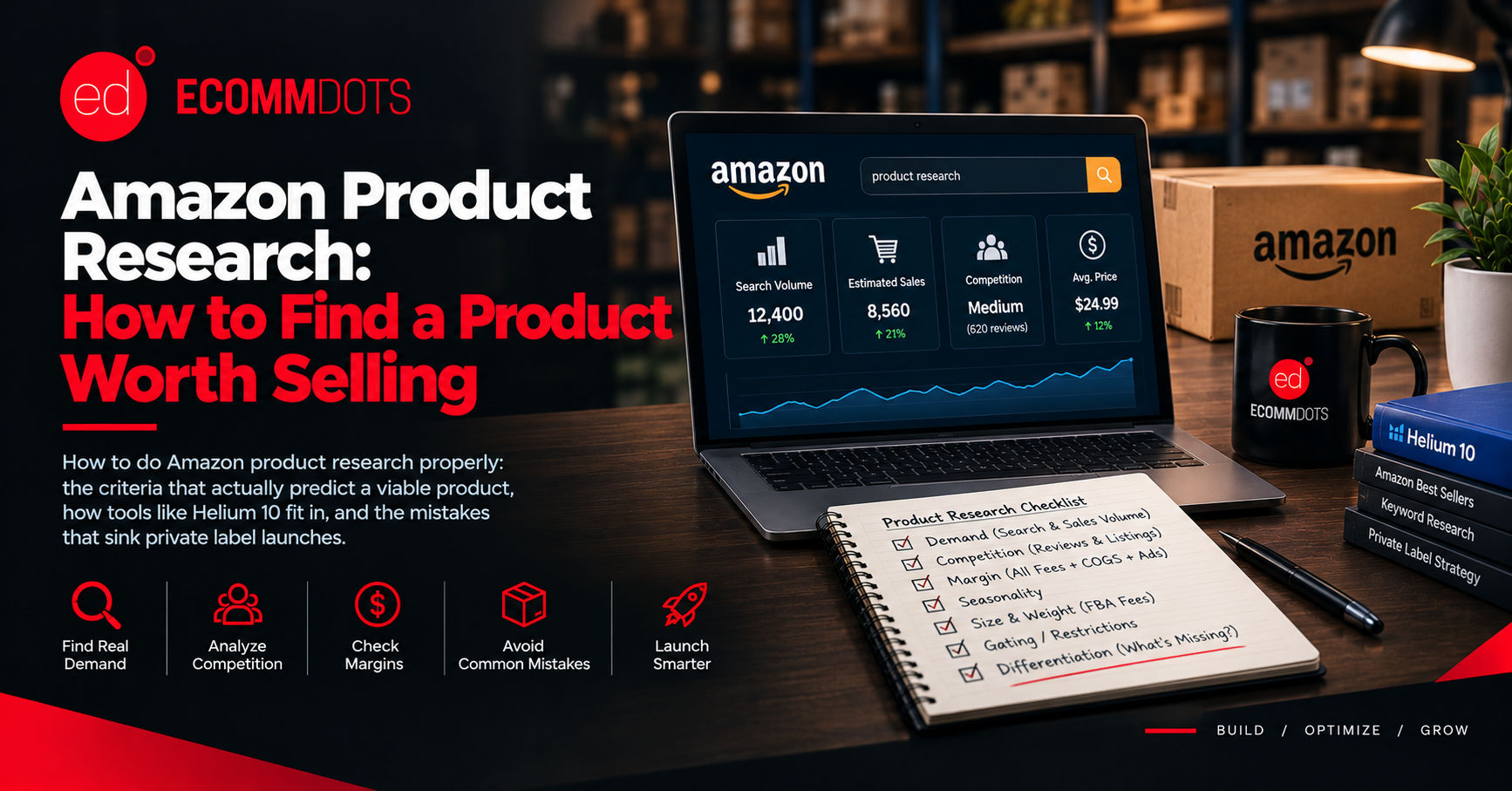
Demand comes first. Look at estimated monthly search volume and sales volume for the main keyword, not just whether the category feels popular. A product with decent demand and weak competition will usually outperform a product with huge demand and hundreds of entrenched listings.
Competition is the second filter. Check how many reviews the top listings have, since a top page full of products with thousands of reviews each is a much harder climb than one where the leaders have a few hundred. Look at how differentiated those listings actually are. If every top result looks identical, there may be room for a genuinely better version, or the category may simply be commoditized.
Margin decides whether winning is worth it. Work out the landed cost per unit, the Amazon referral fee for that category, FBA fulfillment and storage fees if you plan to use FBA, and your advertising cost before you commit. A product that looks exciting at the retail price can turn out barely profitable once every fee is subtracted, which is the same trap covered in our Fulfillment by Amazon guide.
A few more filters catch problems early. Seasonality matters if a product only sells well for part of the year, since that changes your cash flow and inventory planning. Size and weight matter because oversized or heavy items carry higher FBA fees. And restricted or gated categories need checking before you buy inventory, not after.
Where Tools Like Helium 10 Fit In
Tools such as Helium 10 and similar product research software pull estimated search volume, sales estimates, and competition data so you are not manually guessing at demand. They are useful for speeding up the first pass across many product ideas, but the estimates are approximations, not guarantees, and two different tools will sometimes disagree on the same product. Treat tool output as a starting point for validation, not as the final answer, and always sanity check a promising result by looking at the actual search results and listings yourself.
A Practical Research Process
1. Generate a list of product ideas from gaps you notice, adjacent products to something you already sell, or categories you understand well enough to judge quality.
2. Pull demand and competition estimates for each idea using a research tool or Amazon's own search volume signals.
3. Eliminate anything with weak demand, overwhelming competition, or an obviously thin margin before you spend more time on it.
4. For the ideas that survive, calculate landed cost, all Amazon fees, and a realistic advertising cost to confirm the margin actually works.
5. Check the category for gating restrictions and the specific product for any compliance or safety requirements.
6. Look at what the current top listings are missing, whether that is image quality, a feature, a size option, or a use case nobody has addressed, since that gap is usually your actual opportunity.
Mistakes That Sink a Product Before It Launches
The most common mistake is chasing a product because it looks exciting rather than because the numbers support it. A close second is ignoring fees until after ordering inventory, which is how a seemingly profitable product turns out to lose money on every unit. Many new sellers also underestimate how much of the opportunity in a category is really about differentiation, assuming they can compete on price alone against listings that already have hundreds of reviews and an established position.
The Bottom Line
Amazon product research is not about finding a secret nobody else has found. It is about running the same demand, competition, and margin checks consistently, on every idea, before money is spent on inventory. Tools speed up the process, but the judgment on what gap is actually worth filling still has to come from someone willing to look past the sales estimate and ask why the top listings have not already solved it.
Validating a product idea and want a second opinion before you order inventory? Talk to the Ecommdots team and we will walk through the numbers with you.